How to Make Goat Milk Soap DVD

Saturday, August 30, 2008

My Friend is Making Soap

Hi all!
My good friend, Jodi, is making soap from her own goat milk. I gave her one of my videos last year. I'm not sure if she watched it or not. She doesn't use my recipe for goat milk soap and was concerned that her bars of soap are not very hard. She said she uses olive oil, vegetable (soy) oil, and coconut oil in her recipe. I have also had various other individuals ask me about using other oils, like sweet almond oil, castor oil, cocoa butter, shea butter, and more.

It is always a good idea to start with one good recipe and then to modify off that recipe than to just make a totally new recipe. Why? Because with soap, so many things can go wrong and it is difficult to determine exactly what the problem with a soap was, if everything was different. It is a good idea to educate yourself on the properties of the different oils and know what they do for your soap. If you want a hard bar of soap, it is not a great idea to use much castor or sweet almond oil as they make the bar soft. But castor oil can contribute to lather, so use sparingly.

I'm happy my little effort in putting together this video has helped a lot of people get started making soap. Please feel free to leave a comment on your soap making progress!

Enjoy the day!
Cherie

Thursday, August 21, 2008

Soap Making Resources

I am one happy woman!

I have found resource that may make your soap making endeavor just a little less costly. Please check out this link www.suppliersbystate.com and you may be able to find a local resource for your soap making supplies that could save you shipping costs (esp. if you are ordering oils by the pail).

While this is nice, what I am really thrilled with is a link from Illinois that I found for clear labels that you can buy by the sheet. I have never found labels that are crystal clear and I have been looking for them for years. I love making lip balm in Sweetcakes clear lip pots. I have always wanted to put a pretty clear label on top of the lid but could never find one that is crystal clear. Also, I have made customized labels for several organizations that sold my soap and I had always had to use the frosted clear labels, but now....tah dah.....I have found CLEAR! I prefer clear so the customer can see how pretty the soap is through the label. Here is the link fo this label company www.labelsbythesheet.com

Hopefully you will find this sight as helpful as I have!
Enjoy!

Thursday, July 24, 2008

I Have Goats!

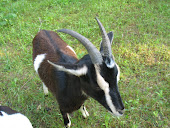
It's been quite a while since my last post. You may be wondering why that is so. Well, in the past several months we have added quite the menagerie to our growing homestead. Two of our new additions are goats! Mary is an Alpine yearling and we will breed her this fall. I can hardly wait to actually have my very own goat milk. Our other goat is a Nigerian Dwarf named Maggie. She was just weaned in May and will most likely be too young to breed this fall.

I really had never spent time with goats before so I was in for a surprise--they are very personable and friendly and my children and I love them very much. I am really looking forward to the next chapter in my soap making--have plentiful goat milk (more than I can possibly use!) for all my soap making endeavors. I can hardly wait.

Saturday, May 17, 2008

Laundry Detergent Project

I am in the midst of a laundry detergent project.
I am trying several different soaps in the recipe to see which detergent I like the best and which one is the most economical to make. I had never thought to make my own detergent before, but with five kids living in the country, I have so much laundry to do that I thought perhaps I could economize on detergent costs if I made my own.
My laundry detergent project has tested using Fels Naptha detergent, ivory soap, and homemade soap. So far I cannot detect a noticeable difference using any of the bar soaps, so my recommendation is to use which ever is the cheapest. I do like my clothes to have a nice (but not overpowering) smell, so if I went with the ivory soap, I would probably add a bit of lavendar essential oil to the deteregent (just note that if you add a fragrance, you also add cost). But a detergent without fragrance is very desirable to many.
You would have a fragrance free laundry detergent with the ivory bar or with your own homemade soap. I would be sure to modify my homemade soap intended for the laundry just a tad. I would strive for a bar that does not have any margin in it (usually I have 5% superfatting for a mild, gentle soap). I think it helps not to have the extra oil in the soap. Again, I have not done a scientific experiment to prove this, but I personally would try to have a bar without margin. If you need help in making your own soap go check out my website at How to Make Soap
I am still working on this project and am sharing the laundry detergents with others to get feedback, so I will post the results as they come in.

Saturday, April 26, 2008

Homemade Laundry Soap

6 cups of water
1/3 bar grated Fels Naptha Detergent Bar (or one whole bar of Ivory Bar Soap or your own homemade soap)
3/4 Cup Borax
3/4 Cup Washing Soda (Arm & Hammer makes this)
1 Quart hot tap water
6 quarts water

Directions:
Dissolve the grated soap in the six cups of water on your stove over medium heat.
Once the soap is fully dissolved, then add the borax and washing soda. Stir until dissolved (a couple of minutes).
You will need a container for your laundry soap that is large enough to hold 3 gallons. In this container, put 6 cups of hot tap water. Pour your hot soap solution into this container and stir. Add the additional 6 quarts of water. This laundry detergent will gel up. It may also separate a bit before it is all used. This is all okay. I like to break up the gel solution and pour it into old laundry containers I have saved. I generally shake the bottle before using to allow it to pour well.
Use 1/2 cup for one load. I like to use one full cup of detergent and add an extra Tablespoon of borax when I wash my towels (especially if they have been damp and waiting in the laundry basket a few days).

You may also add some essential oil to your laundry detergent when you are incorporating all the water.
Enjoy!

Monday, April 07, 2008

How to Package Soap Continued


I ordered some sample gusset polybags from the SAKet Co. I found that 2 1/2 x 1 1/4 x 7 1/2 gusset bag is the perfect size for a bar of soap (well, perfect if you use my recipe and soap mold from my DVD "How to Make Goat Milk Soap with Oatmeal." ) If you are packaging soap to sell, the price couldn't be more reasonable. 1,000 bags are $24.28 which breaks the cost down to 2 1/2 cents per bag.

I tie my bags with an approx. 12 inch piece of ribbon. I just use inexpensive organza ribbon and try to keep the same color ribbon on the same kinds of soap. This makes my display pretty and helps me identify my soaps quickly. I have found that many people like the soap packaged this way at craft shows because many of my customers purchase soap for gifts.

Having the soap packaged like this makes a nice gift for teachers, babysitters, grandmas and other relatives, etc.

I believe the total cost of packaging my soap this way about 10 cents per bar. If you sell your soap for $4.50 per bar (4 oz.) you should be able to make about $3.40 - $3.90 profit depending upon your fragrance and other ingredients in your soap.

You can find this website at The Saket Company.

It is also easy to attach lables for your soap on the back side of your packaging. I use address labels that you can purchase at an office supply store ( I get the size where thirty address lables are on one page).

You are not required by law to list your ingredients, but if you don't, it is nice to have a brochure to hand out that lists the types of ingredients you use in your soaps. I like to list ingredients on my labels as well as my company's name and a way for a customer to reach me (phone number and email/website).
PREVIEW MY DVD HERE!!

Recommended for Essential Oils

Camdengrey Essential Oils